
Contents
(Click on link below to be taken directly to that section)
Download the Recruitment and Initiation Guide
Circle Membership Process
- O∆K seeks to identify, celebrate, and engage collegiate and community leaders from different backgrounds, perspectives, and generations.
- The circle’s goal should be to cast a wide net to recruit all campus and community leaders who emulate our mission and values and meet our membership criteria. This includes undergraduate students, graduate students, faculty, staff, and community leaders.
- A circle should initiate individuals from each of the five pillars of campus life.
The Membership Cycle
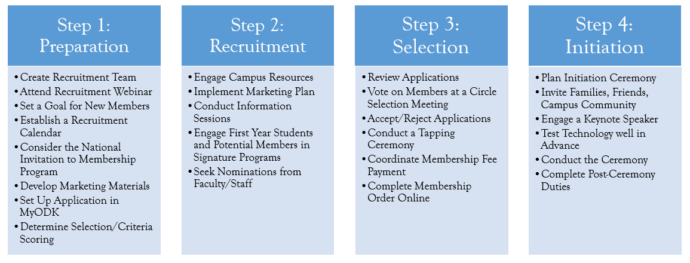
General Notes on Recruitment
- Recruitment is specific to each circle; however, the most successful circles do the following:
- Establish a firm timeline and maintain it year after year. This recruitment pattern becomes known on campus so a leader can anticipate the recruitment cycle.
- Delegate the bulk of the day-to-day recruitment operations to a membership committee with an elected/selected chair. The circle officers should oversee but not manage the process.
- Establish firm target estimates of new members needed to grow the circle in numbers, diversity, or both.
- Market heavily across campus, including via emails, postings, and invitations to nominations from senior administrators and faculty.
- Conduct information sessions online for students who may be eligible but are not aware of O∆K
Recruitment Timeline
( download the Interactive-Circle-Recruitment-Timeline-90-60-45)
- The recruitment timeline provided here is a recommended template for a 45-day efficient recruiting period. The timeline does not include some additional preparation time.
- 45 days is more than adequate to conduct a comprehensive recruitment process, including information sessions, application reviews, and circle voting, culminating in an initiation ceremony.
- The entire process can be managed virtually because the application, payment, and initiation ceremony can all be completed online. Familiarity with Zoom, WebEx, and other conferencing software enables circles to hold information sessions and meetings for voting without needing to be in the same room.
Recruitment Process
- Recruitment is specific to each campus.
- Develop relationships with freshman and sophomore programs to identify potential leaders.
- Make it personal – invite potential candidates to circle meetings or virtual forums.
- Utilize campus resources to compile a list of the top 35%.
- Make sure you include all five pillars.
- Once you have your recruitment plan, you are ready to navigate the Member Management System.
Recruiting ALL Campus Leaders
- OΔK was founded on the principle of bringing together the leaders of different campus constituencies.
- We are a SELECTIVE honor society. Selective means we have specific criteria, but beyond those, we DO NOT EXCLUDE anyone who meets the criteria.
- We have only three (3) primary criteria.
- Class: Undergraduates must be a sophomore, junior, or senior (as determined by the institution) with at least one full term of enrollment at the institution.
- Academic Eligibility: Undergraduates must be in the top 35% of their class and enrolled for at least one/half year. Each circle determines graduate/professional academic eligibility.
- Leadership: Undergraduate students, Graduate/Professional students, Faculty/Staff, and Alumni must have demonstrated leadership on campus and/or in the community.
Guidelines for Including Sophomores
The Mission Committee and National Headquarters staff recommend the following guidelines for circles to consider as they incorporate sophomores into a circle.
1) Definition of Class
Omicron Delta Kappa has five classes of membership as defined by the O∆K Policies and Procedures: Undergraduate student, graduate student, faculty or staff member, alumni, and honorary (honoris causa). The undergraduate class is divided into three sub-classes: sophomore, junior, and senior. At some institutions, these are known by other designations, such as second-year, third-year, and fourth-year. The graduate student class includes students in graduate and professional programs, such as law, medicine, dentistry, and pharmacy.
2) Determining the credits required for a class.
The O∆K Policies and Procedures state that institutional guidelines determine a student’s class. The credit hours required to attain each sub-class vary, but the list below can be used as a guide.
-
- Sophomore, or second-year, typically has at least 30 credit hours completed
- Juniors, or third-year, are typically 60+ credit hours completed
- Seniors, or fourth year, are typically 90+ credit hours completed
Circles should include in their local bylaws what the institutional criteria for determining the class of a potential initiate is so that it is clear to any candidate what the class level.
3) No Requirement to Initiate Sophomores
There are no provisions in O∆K Policies and Procedures that prevent circles from accepting only one class of students; however, circles are strongly encouraged to initiate all classes in accordance with policies that limit graduate, faculty/staff, and alumni initiations. The Society strongly discourages any self-limiting practices. Circles should be open to the broadest possible pathways for recruiting and initiating members, as the policies and procedures allow.
4) Strategy for the Initial Inclusion of Sophomores
Each circle is expected to develop a strategy for the inclusion of sophomores into the circle. The strategy should include three basic principles:
-
- Purpose
- Specialized Leadership Development
- Numeric Targets – determine how many of each class you intend to initiate
5) Sophomores must have full membership status
The revised O∆K Policies and Procedures now include sophomores as full members of O∆K. Circles may not in any way create a system that allows for sophomores to be considered anything less than full members. Criteria for circle officer positions may include expectations of experience within the circle, but should not be written in a way that always excludes sophomores from executive leadership.
6) Petition to increase the maximum number of initiates
The O∆K Policies and Procedures place maximum limits on the number of undergraduate students a circle may initiate based on the undergraduate population. At this time, very few circles ever approach their maximum number. If the inclusion of sophomores in significant numbers would conflict with the maximum limit, a circle may petition the National Headquarters for a waiver. Waivers will be granted for two years. The National Headquarters will monitor the requests and if it becomes necessary to change the maximum percentage allowed for all circles, the National Headquarters will work with the Mission Committee to propose recommended changes to the maximum levels.
Honorary Membership (Honoris Causa)
Each circle may induct up to four Honorary (Honoris Causa) initiates each academic year and have the initiation fee waived for one of them. Circles located in institutions having a student matriculation of less than 1,000 shall not elect more than two honorary members during any one academic year. Circles located in institutions with more than 1,000 students may elect a maximum of four honorary members during any one academic year. Honorary members may be asked to complete the online membership application, or an institutional representative may complete the form on that individual’s behalf through the Special Membership Application in the MyODK Circle Executive Dashboard.
Commitment to Our Value of Inclusion
- OΔK has redoubled its commitment to increasing recognition of individuals from underrepresented populations.
- For OΔK to have membership representative of the future of this country and the world, we need our circles to expand their recruitment practices.
- The recommendations in this section are designed to guide circles in seeking out leaders who may not be recognized in traditional leadership programs.
Suggestions for Inclusive Recruiting
-
- Move beyond traditional avenues of recruitment.
- Be sure to include recruiting efforts through Historically Black, Hispanic/Latino, Asian, and other fraternities and sororities.
- Host online information sessions specifically for these groups and others that may be traditionally underrepresented in your membership.
- Invite faculty/staff members with connections to special programs to recommend leaders for membership.
- Seek faculty and staff persons of populations not readily represented in your circle to recommend individuals and to be recruited as possible members.
- The most crucial factor is to open the recruitment process to underrepresented populations within your circle and even your institution.
Selection based on the Five Pillars: Horizontal v. Vertical Leadership
- Recruitment and selection from the five pillars should look for leaders who have either breadth across multiple pillars or depth in one pillar. This involves identifying Horizontal Leadership or Vertical Leadership.

- Horizontal Leader: One engaged as a leader in many different pillars of campus life.
- Presented research at a conference = Academics
- Writes for the campus paper = Communications
- Leads the campus food pantry = Service
- Vertical Leader: One who has engaged deeply in leadership in one pillar of campus life.
- Lead role in theater productions = Arts
- Directs one-act plays = Arts
- Served on the arts council = Arts
- Each leader has much to contribute to a circle and to OΔK as a whole.
- If you balance the Horizontal and Vertical, you will complete the Circle!
Use National Recruiting Materials
Applications and Fees
All potential members of Omicron Delta Kappa must create a profile on MyODK (my.odk.org) and complete the Omicron Delta Kappa National Lifetime Membership Application.
All regular initiates must pay the National Initiation Fee ($94.00) before initiation.
The membership form can be tailored to the circle’s needs, so there is no need to use a separate application.
Circle advisors and student presidents can download and review the applications. Membership fees may be paid through the circle or online through the national membership payment portal in MyODK.
Once all applications have been approved and membership fees collected, one of the circle advisors must complete the Membership Certificate Order. Please note: the certificate order should not be submitted until the circle has received payment of fees directly OR received verification that the fees have been received through the portal.
