
When speaking to students, professionals, and civic leaders about leadership I usually ask: what do you think leadership actually “is”— or what do leaders “do”?
Random musings ensue: “it’s about vision”, “motivating others to do what you want them to do”, “getting failing teams to perform better”, “turning around a dysfunctional company” “giving hope an belief to a nation”, “bringing insight to a congregation”, “serving the less fortunate” or even “getting myself to stop smoking!”
A thousand and one principles, concepts, theories, and tools are used to “do” leadership, but there are so many moving parts, I liken it to a cloud of butterflies, each representing a particular element that contributes to the leadership equation. In beautiful forms and lovely patterns these lovely creatures ebb and flow based on internal drivers, external conditions, and the fluttering community’s objectives. Said differently, leadership can be difficult to slice and dice into nifty packages. It’s not just 7 of this or 5 of that, but many inter-connecting parts—all of which are important—but when?

We know good leadership when we see it, but we often fail to tease out the equation in that moment. Is leadership about charisma, power, intellect, foresight, hindsight, effective communication, emotional intelligence, risk taking, building trust, empowering others, organizing resources, building synergy, energizing the crowd…? Is there a beginning or an end—or is it a never-ending journey and process?
Perusing through the history of leadership we usually begin with the “Great Man Theory” (those born with “the stuff” of leadership). We then explore “traits”. With many researchers disproving many of these assumptions, we move into “behavioral”, then “contingency” and “situational” theories putting emphasis on time, place and circumstance.
Seeking to take this further, enter what I call “The Theory of Attentional Leadership” or “Attentional Leadership Theory” (ALT). This theory suggests that leadership is exercised where, when, and for what duration one’s attention is given to influence human systems towards valued objectives—in any Meaningful Life Arena (MLA). ALT seeks to provide a “binding” and/or a “bounding” framework for leadership’s many contributing literatures, models, and practices.
Attentional Leadership Theory (ALT) begins with the premise that all science—including the study of leadership—begins with a particular arena of study to identify reliable and valid principles that inform the “practice” of leadership. It’s a young science, but it’s progressing.
ATL suggests that 15 intersecting “dimensions” or “blocks” (internal, external, and time) frame the bulk of leadership principles, theories and practices.
ALT suggests that leadership is an “inside out” process—starting with the individual—the fundamental unit influencing or being influenced (leading or being led). Internally the 5 conceptual blocks include the physical, emotional, psychological, philosophical, and spiritual. Within these blocks are numerous sub-literatures, but for the purpose of introduction we’ll keep this focused at the “big block” level.
Leadership begins with self. Full personal engagement means tapping into the physical emotional, psychological philosophical, and spiritual dimensions that drive human behavior and engagement. ALT suggests that leadership moves from leading self to leading in relationships, teams, organizations, and communities (regional, national, international). At each of these levels we can see the underlying physical, emotional, psychological, philosophical, and spiritual blocks—suggesting that as we move from leading self to others, the same core internal human dynamics are at play.
Recognizing that leadership is never static, we look at 5 blocks of time. We begin by planning for the Long Future (mission, vision, legacy), through the Short Future (goals, preparation, planning), Focus (execution in the moment on what’s most important now—or WIN), Short Past (feedback loops and learning), and Long Past (collected experiences and wisdom).
Intersecting these 3×5 dimensions we see a the following meta-framework for understanding the broader aspects of leadership theories and practices:
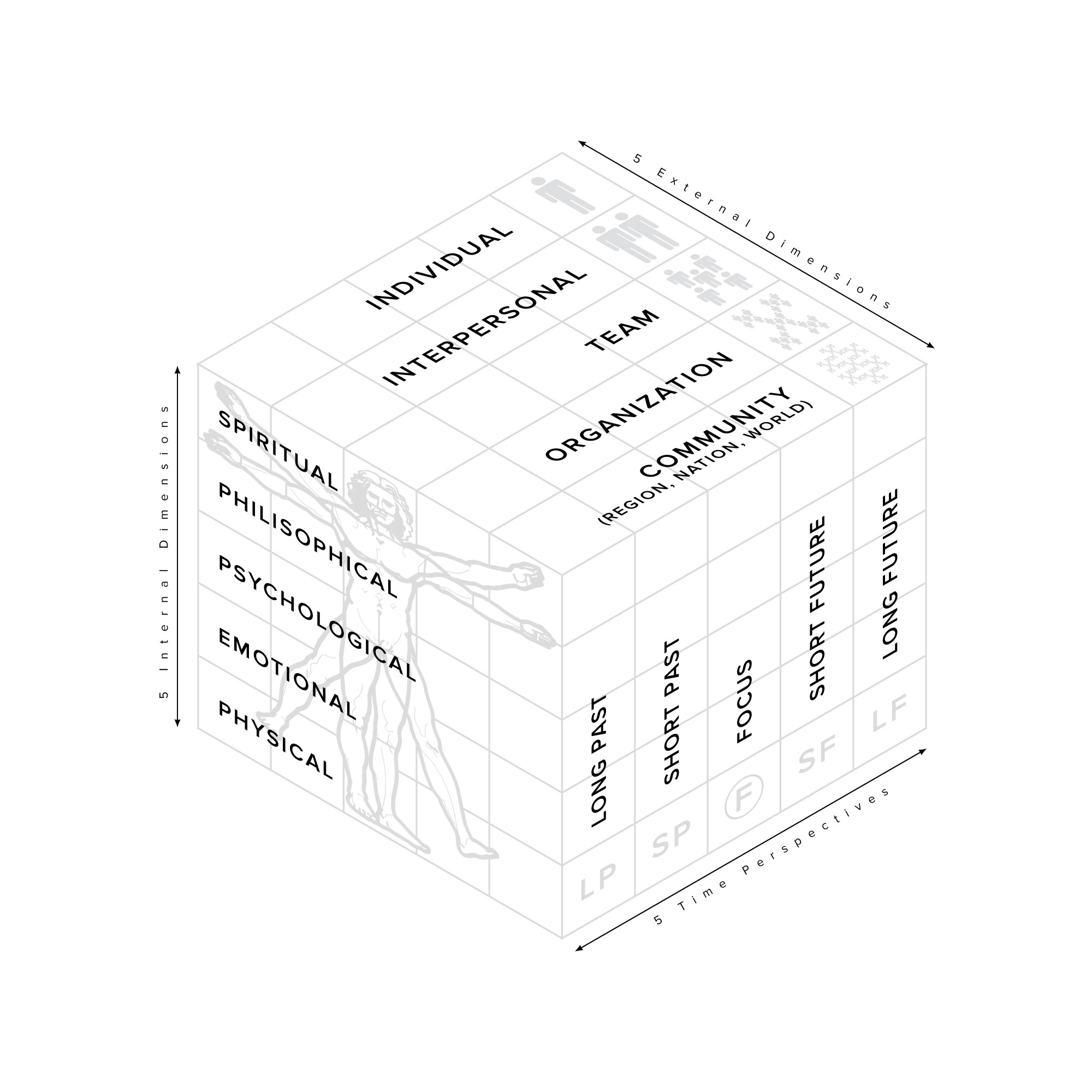 With these 125 intersecting parts, you can take apart just about any leadership theory and practice and identify what combination of elements are at play for a leader to attend to moment by moment—the only way leadership is exercised. ALT therefore seeks to validate all relevant theories, but makes the unique proposition that leadership and human influence (at the highest levels) take place within and between these various intersections and that effective leadership is not just situational, but attentional.
ALT suggests that effective leaders must see the larger systems and processes (from the past, in the present, and in the future), how they inter-mingle, and how they influence one another—in any arena—at every level—at any moment in time.
Every block or combination of blocks have their time, but it’s the effective leader that knows what’s at play, what to attend to, and where to place, time, energy, and resources (using useful models and tools) to effectively influence the human systems within the arena they are leading—and that begins with self.
Dr. Bruce Jackson is the president of The Institute of Applied Human Excellence, a human performance consulting firm dedicated to excellence at every level of the organization. Dr. Jackson was the director of the nationally recognized Center for the Advancement of Leadership at Utah Valley University. He also serves as an Associate Consultant for Ascent Advisor and Executive Director for the C. Charles Jackson Foundation.
