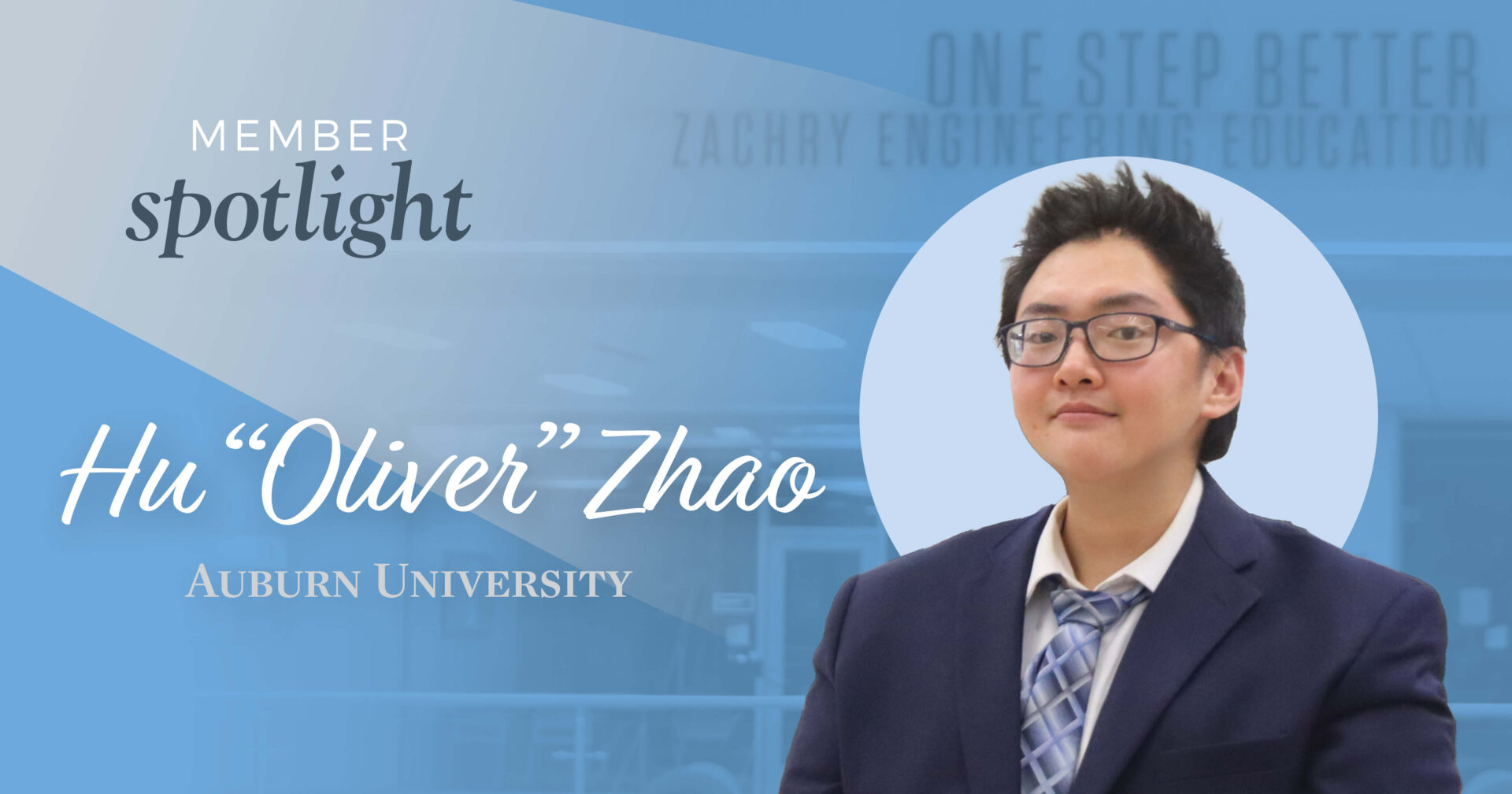
 Leadership is often forged in moments that test the very structure of our lives. For Hu “Oliver” Zhao (Auburn University, 2020), those moments became the foundation for a life dedicated to resilience, service, and designing systems that help communities endure and recover.
Oliver is currently a doctoral student in civil and environmental engineering at Texas A&M University, where his research in urban resilience examines how infrastructure, data, and human behavior intersect in the wake of disasters. Working under Dr. Ali Mostafavi, he analyzes real power-outage and demographic data to understand why some communities recover faster than others—and how engineering and policy can close those gaps. His work reflects a powerful belief: resilience is not just about structures, but about people.
That belief is deeply personal. Shortly after completing his master’s degree at UCLA, Oliver survived a life-threatening traumatic brain injury that required multiple surgeries and a long recovery. Rather than detouring his path, the experience reshaped his purpose. Today, his research, leadership, and writing all center on one question: what allows systems—cities, communities, and individuals—to keep running after disruption?
Beyond the lab, Oliver has served in numerous leadership roles, including president of Tau Beta Pi at Texas A&M, associate editor for The Transit of Chi Epsilon, and an officer in the Graduate Student Association. A Clinton Global Initiative University Fellow and alumnus of the World Economic Forum’s Global Shapers Houston Hub, he demonstrates a global, service-oriented approach to engineering and leadership.
His journey—from Auburn Honors Scholar to UCLA graduate student to Texas A&M Ph.D. candidate—demonstrates how perseverance, intellectual curiosity, and a commitment to others can transform adversity into impact. Through his philosophy of “Resilient Structureism,” Oliver connects technical research with the human experience, reminding us that leadership is ultimately about helping others continue forward.
We invite you to read Oliver’s leadership story in his own words:
“I never had a perfect, uninterrupted trajectory. I had brain surgery. I lost part of my skull. I woke up unsure what day it was. But I rebuilt my system. My work in urban resilience is not just about data or infrastructure—it is about understanding how people, networks, and communities keep running when everything else stops. I joined honor societies not to collect titles, but to gain a platform to talk about recovery, service, and hope.
At Texas A&M, I study how households recover after disasters, but the same principle guides my life: structure first, make it work, ignite others. Resilience is not perfection; it is repairability. If we can design systems—and lives—that allow for failure, adaptation, and reconnection, then we create a future where more people can continue. I survived because someone stopped and called for help. My work is my way of paying that forward.”
— Hu “Oliver” Zhao (Auburn University, 2020)
Share your O∆K story with us!
As part of our mission to identify, honor, and develop leaders in collegiate and community life, we love to highlight our members. Share your leadership journey, experiences, and impactful moments. Your narrative enriches our community and inspires others. Be a source of motivation and connection within O∆K. Your voice matters—become a member spotlight and lead the way for fellow members. Member Spotlights will be shared on O∆K’s website, social media channels, and potentially in The Circle and other O∆K digital and printed publications. Fill out our Member Spotlight form here.
